





Eye Accessing Cues
By Roger Ellerton Phd, ISP, CMC, Renewal Technologies Inc.
This article may not be republished without written permission from Roger Ellerton/Renewal Technologies Inc. If you republish this article without permission, you will be in violation of copyright law and sent an invoice. You may share this and other pages with your friends by linking directly to this page from your website or blog.
Have you ever noticed that people's eyes move when they are thinking? This is valuable information that can provides us with clues as to whether they are thinking in pictures, sounds, feelings or talking to themselves. Or in other words, information about their lead and preferred representational systems.
William James (Principles of Psychology, 1890) first suggested that internal representations and eye movements may be related. This observation was not explored further until the 1970's when Richard Bandler, John Grinder, Robert Dilts and others conducted further experimentation in this area.
According to neurological research, eye movement both laterally and vertically seems to be associated with activating different parts of the brain. In the neurological literature, these movements are called lateral eye movements (LEM) and in NLP we call them eye accessing cues because they give us insights as to how people are accessing information.
To get an idea how your eyes move, consider the following questions. For each question, as you think of the answer, notice the direction(s) your eyes move (up down or to the side) or if your eyes do not seem to move notice if you have a sense that you are looking in a certain direction (even if only for a fraction of a second).
- What is the colour of your front door?
- What will you look like in 15 years?
- What does your favourite music sound like?
- What would your voice sound like if you had marbles in your mouth?
- When you talk to yourself, what type of voice do you use?
- What does it feel like to be in a nice warm bath?
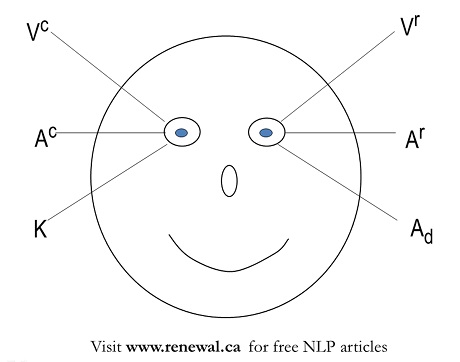
Did you notice your eyes had a tendency to look up for the first two questions, to the side for the next two questions and down for the last two questions? In general, if you are making a picture in your mind your eyes will tend to go up to the left or the right, for sounds laterally to the left or right, and down to the left or right for feelings or when you talk to yourself.
More specifically, if you are right-handed, you may have noticed the following (for people who are left handed, interchange left and right in the following text):
- Question 1 - eyes up and to your left. This is a question about something you have seen before and hence you remembered it -- visual remembered (VR).
- Question 2 - eyes up and to your right. This is a question about something that I assume you have not seen before and hence you constructed this picture - visual constructed (VC).
- Question 3 - eyes on the horizontal plane to your left. This is a question about something you have heard before - auditory remembered (AR).
- Question 4 - eyes on the horizontal plane to your right. This is a question about something you have not heard before - auditory constructed (AC).
- Question 5 - eyes down and to the left. This is a question about your self talk - auditory digital (Ad).
- Question 6 - eyes down and to the right. This is a question about your feelings- kinesthetic (K).
Note: The above eye patterns are how your eyes would move if you are right-handed. The following picture describes the eye patterns for a right-handed person as you look at them - please note this distinction. These patterns are fairly consistent across all races, with the possible exception of the Basques, who appear to have a number of exceptions to the rule. For many left-handed people, the chart is reversed i.e. mirror image.
Eye Pattern Chart
Looking at the Other Person
If you would like to have some fun with your friends or family, here are some other questions you can take turns asking each other - or you can make up your own.
Visual Remembered
What is the colour of the shirt you wore yesterday?
Which of your friends has the shortest hair?
Visual Constructed
What would your room look like if it were painted yellow with big purple circles?
Can you imagine the top half of a tiger on the bottom half of an elephant?
Auditory Remembered
What does your best friend's voice sound like?
Which is louder, your door bell or your telephone?
Auditory Constructed
What will your voice sound like in 10 years?
What would it sound like if you played your two favourite pieces of music at the same time?
Auditory Digital
What is something you continually tell yourself?
What are your thoughts about this article?
Kinesthetic
What does it feel like to walk barefoot on a cool sandy beach?
What does it feel like when you rub your fingers on sandpaper?
People's Eyes do not Always Move
Sometimes people's eyes do not move and this may be due to:
- Look to talk rule: Some people have a look to talk rule. That is, when you are making eye contact with them, they will also look at you and their eyes will seem not to move or move very slightly and quickly. What may be happening in this situation, is that they are defocusing their eyes so that their 'internal' eye can look in the appropriate direction.
- Near term memory. If the answer is something that is well-known to the person (i.e. What is their name?) or is a recent observation, then they do not need to search for the answer and their eyes will not move.
Using Eye Patterns to Assess Truthfulness or Congruence
If a person is describing something that they have seen or heard, then their eyes should primarily move to visual or auditory remembered. However if a person is making something up, then their eyes will tend to move to visual or auditory constructed, indicating that the person is constructing some part of the situation they are describing. This may indicate that the person is uncertain or untruthful about what they are thinking.
Be careful assuming someone is untruthful. For example, suppose you asked me a question about something that I had never thought about before. To formulate an answer, I may have to look at or hear one or more pieces of true information in a way that I had never done so before. In this situation, I would be constructing an answer and my eyes would most likely move to visual or auditory constructed.
Lead and Preferred Representational Systems
People have habitual eye movements related to their lead and preferred representational systems.
I am right-handed and my lead system is auditory digital. If you were to ask me, what is the colour of my front door, my eyes would first go down to my left (auditory digital) before going up to my left (visual remembered). Why? Because the first thing I would do is repeat the question and make sense of it (auditory digital), and then get the answer (visual remembered).
In a similar manner, if your lead system is visual and I asked you what does it feel like to be in a nice warm bath, you would probably get a picture of being in the bath (visual remembered) before accessing the feeling.
Your preferred representational system is the sensory modality (visual, auditory, kinesthetic, auditory digital) you use to organize and understand some experience or situation. If I am speaking to someone or giving a presentation and I notice that their eyes keep going up to visual, even if I am not using visual words or pictures, then this is a clue that they may be forming visual internal representations and their preferred representational system is visual. On the other hand if their eyes are tracking on the horizontal plane, then they are processing in sounds and their preferred representational system is auditory. If their eyes are going down, then they may be processing kinesthetically or making sense if what I am saying (auditory digital). If in addition, their eyes are going down to the right and they are right-handed, then their preferred representational system is most likely kinesthetic.
Building Your Confidence in Reading Eye Accessing Cues
There are a number of ways to practice reading eye accessing cues, here are two:
- Practice with your friends (with their permission): Watch their eye accessing cues and then verify your observations with them.
- Watch talk shows on TV (make sure it is spontaneous and not rehearsed.). This is a great way to practice as you can stare at the people on the TV and it will not bother them at all. Notice if there is a relationship between where the person looks and the predicates they use i.e. if the person's eyes are looking up, do they tend to use more visual words?
And NLP is Much more than that!
Author: Roger Ellerton is a certified NLP trainer, certified management consultant and the founder and managing partner of Renewal Technologies. The above article is based on his book Live Your Dreams Let Reality Catch Up: NLP and Common Sense for Coaches, Managers and You.
Copyright © 2004, Renewal Technologies Inc. All rights reserved.
