
NLP Logical Levels, Part I
By Roger Ellerton Phd, ISP, CMC, Renewal Technologies Inc.
This article may not be republished without written permission from Roger Ellerton/Renewal Technologies Inc. If you republish this article without permission, you will be in violation of copyright law and sent an invoice. You may share this and other pages with your friends by linking directly to this page from your website or blog.
The NLP logical levels (also known as the logical levels of change, the logical levels of thinking and the neurological levels) are very useful for assisting with or understanding change from an individual, social or organization point of view. They were developed by Robert Dilts and are based on the "neurological levels" proposed by anthropologist Gregory Bateson.
Six Logical Levels
Level |
Questions corresponding to logical levels |
Spirituality/Purpose |
Who else? For whom? This can be viewed as your connection to a larger system. If you are an individual or company providing NLP related services, what impact are you having within your community, where you live and work, the NLP community, your culture and the culture of others, ... ? |
Identity/Mission |
Who? Who are you as an individual or company? What role do you play to achieve your purpose? How do you think of yourself as a person/organization - i.e. I am a successful person. |
Beliefs and Values |
Why? Why do you do something? What do you believe in or value? As an individual, you may believe you can do anything you choose. Or you may value honesty. From a company perspective, the company may value good customer service and/or the well-being of staff. |
Capabilities/Strategies |
How? How do you go about doing things? As an individual or company, what are your capabilities, skills, strategies or action plans? |
Behaviours |
What? What are your behaviours? |
Environment |
Where? When? With Whom? Where, when and with whom do you display your behaviours? What are the external influences on you? |
An Example:
To gain an appreciation of how these logical levels work, assume it is 9:00 am and I am at my place of work (environment).
If I don't want to be there, then I must change my behaviour. Some possible choices are: I could walk out. I could do cartwheels over to and out the door. I could start yelling and screaming - with the hope someone would take me out of the building. Etc.
The behaviour I select depends on my capabilities/strategies. If I am capable of performing cartwheels, then this is certainly a possibility. On the other hand, my strategy may be to have someone help me to leave (i.e. by yelling and screaming). Or, if I really don't want to work there and need some source of income, my strategy might be to become ill so that I have a medical excuse and can go on long-term disability - know anyone who has done this - consciously or unconsciously?
The capability/strategy I choose will depend on my beliefs and values. If I believe that I can easily get another job to support my family, then becoming ill is not a choice for me.
My beliefs and values are determined by my identity. If I see myself as a successful person, then it is very possible that I would hold the belief that I can easily get another job or even create a business of my own.
My identity is dependent on my purpose in life - the impact that I wish to have on my community, etc.
Sustainable Change
Making a change at a lower level (i.e. environment - moving to a new city) may, but not necessarily, affect an upper level. However, a change at an upper level (i.e. belief) will have a distinct impact on the levels below it, as illustrated in the above example.
Using Logical Levels to Explain/Understand Change
The above leads to a number of interesting explanations/discoveries:
- Short-term vs. long-term change: Sometimes people find that NLP
techniques worked great at changing an unwanted behaviour for a short period of
time, and eventually the unwanted behaviour returned. How can this be? If the new
behaviour was not in alignment with the person's beliefs and values or identity, the
higher level would override the lower level.
For change at the behaviour level to be long-term, the desired behaviour change must either be in alignment with the higher levels or the change must take place at a high level i.e. identity.
- Organizational change: Have you ever been involved in change within an
organization? What are some of the more common change activities?
How about a new organization chart? Or maybe change the physical layout of the offices. This is change at the level of environment. Do you think it will be long-lasting? Only if the change is in alignment with the higher levels.
Or maybe staff are told to perform in a different way (behaviour) without receiving the necessary training (capability/strategy). Unfortunately, this happens far too often. When money becomes tight, the first thing cut is the training budget! Again the change will most likely not be long-lasting.
- Health/Career: Suppose you have a goal for yourself (health, career, ...) and it is not in alignment with one of the higher levels. How successful do you think you will be in achieving your goal?
- "The problems of today can only be solved at a higher level of thinking than that which created them" - Albert Einstein: I have heard many people refer to this quote and few can explain how you can actually do it (i.e. move to a higher level of thinking). Using logical levels, you can easily explain it. For example, if there is a problem at the behavioural level, to solve it we must move to at least the capability/strategy level.
NLP can assist you in making change at the higher levels (beliefs and values, identity and spirituality/purpose) or can help you to ensure that your goals are aligned at all levels. Once this happens, your goals in life often become clear and obtained effortlessly.
Other uses of the logical levels and an exercise to assist you with achieving personal congruence - all of the levels are in alignment - are presented in the article, NLP Logical Levels, Part II.
And NLP is Much more than that!
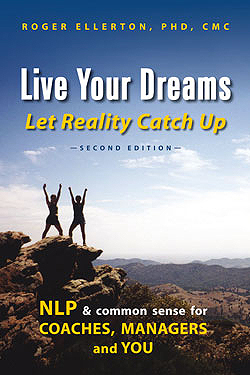
Author: Roger Ellerton is a certified NLP trainer, certified management consultant and the founder and managing partner of Renewal Technologies. The above article is based on his book Live Your Dreams Let Reality Catch Up: NLP and Common Sense for Coaches, Managers and You.
Copyright © 2003, Renewal Technologies Inc. All rights reserved.